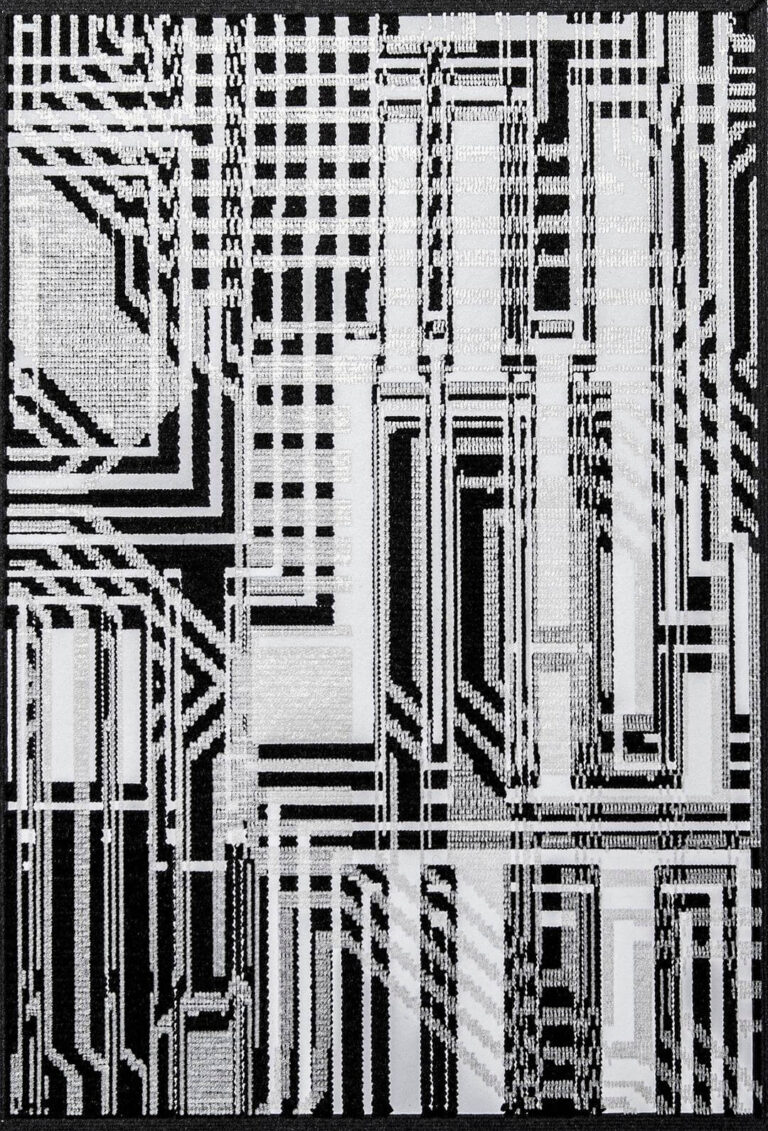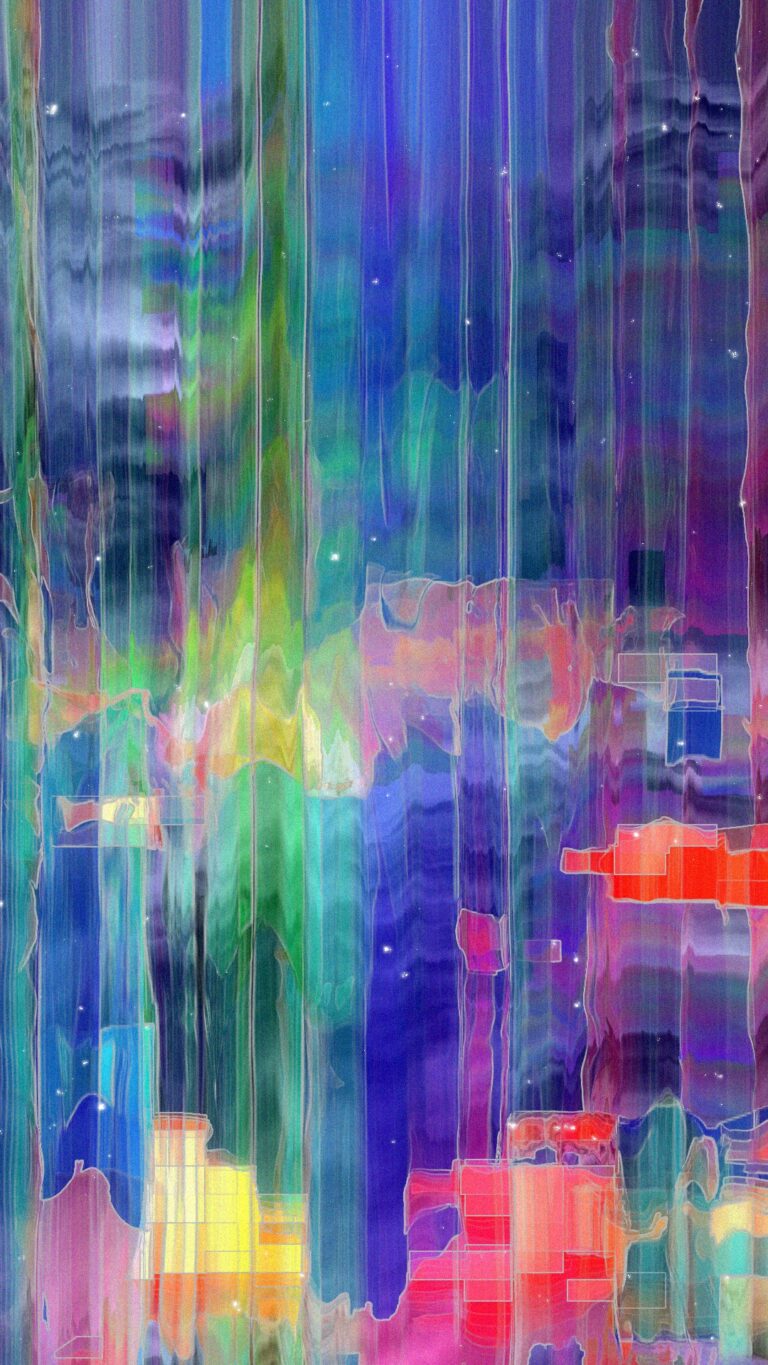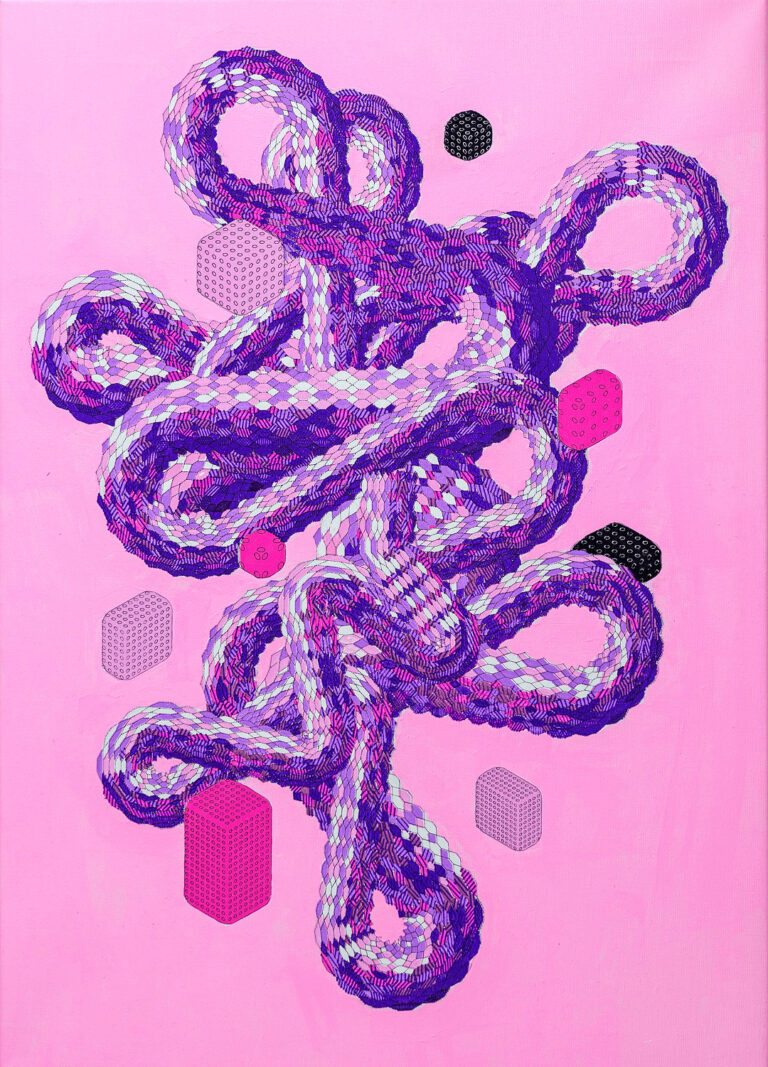
I believe you can’t be an artist without curiosity—you have to listen both inside and outside yourself. Creativity is everywhere, but you must be open and attentive to find it. What I imagine, the music I listen to, my mood, what I read, or even the season light —all influence my work. I set simple parameters, like a color, a shape, an emotion, or a medium, and let the process unfold. As Pierre Soulages said: “It’s what I do that teaches me what I’m looking for.”
ARTIST BIO
I’m a curious artist and enthusiastic pen plotter based in Paris, France. Passionate about drawing, painting, photography, and graphic design, I have been living in a world of images for a long time. After studying at the French Beaux-Arts, I became an architect and have specialized in 3D rendering as a freelancer for over 15 years. Being multidisciplinary artist opens to new horizons, I recently began exploring pen plotting after a year of cyanotype. Even the simplest tool can spark a meaningful story. I love to test and experiment with new techniques, always creating visual sensations and poetic abstractions.
- Web: https://lballix.com/
- Instagram: lb.allix


What Is one belief, insight, or idea that guides your creative process?
I believe you can’t be an artist without curiosity—you have to listen both inside and outside yourself. Creativity is everywhere, but you must be open and attentive to find it. What I imagine, the music I listen to, my mood, what I read, or even the season light —all influence my work. I set simple parameters, like a color, a shape, an emotion, or a medium, and let the process unfold. As Pierre Soulages said: “It’s what I do that teaches me what I’m looking for.”
Can you tell us how you discovered Mixed art and what drew you into it?
I have always been fascinated by the link between digital and analog media. I made many cyanotypes—an ancestor of photography—starting from digital photos or computer-generated images and painting mask from generative pattern. A year ago, I began using a pen plotter, it’s like giving an arm to my computer. Aiming to create SVG files, and quickly realized there are countless ways to achieve them. I learned Processing, P5.js, and Python. Coding became a new creative tool: I define the rules, observe each iteration, and eventually select the perfect one to plot. I wish I had known about Vera Molnar’s story and fantastic work earlier.
What do you think defines your style or creative approach, and how did you arrive at that identity?
I don’t see style as something fixed—being reductive would limit my curiosity. I prefer to surprise myself every day. I would be unhappy if I were locked in a “niche” and repeated the same work. While I’ve been composing mainly in square formats for a few years, I’m now considering escaping into landscape format! The balance between abstraction and figuration always questions me. My approach is about exploration, not confinement to a specific style.
How does a project usually begin for you? Do you have a creative ritual or structure you follow?
I don’t follow a strict ritual but I prepare the ground and plant the seeds of inspiration. I carry a small Moleskine everywhere to jot down notes, sketches, quotes, and references—or I use my computer. My “Arts” hard drive is organized into three folders: Inspiration, Projects, and Portfolio—what comes in, what I’m working on, and what comes out. Working in any of these areas always sparks new ideas, even if they aren’t immediately realized. It is an ongoing process with multiple ramifications waiting to be continued.
What tools or technologies do you use most, and how do they influence your visual language?
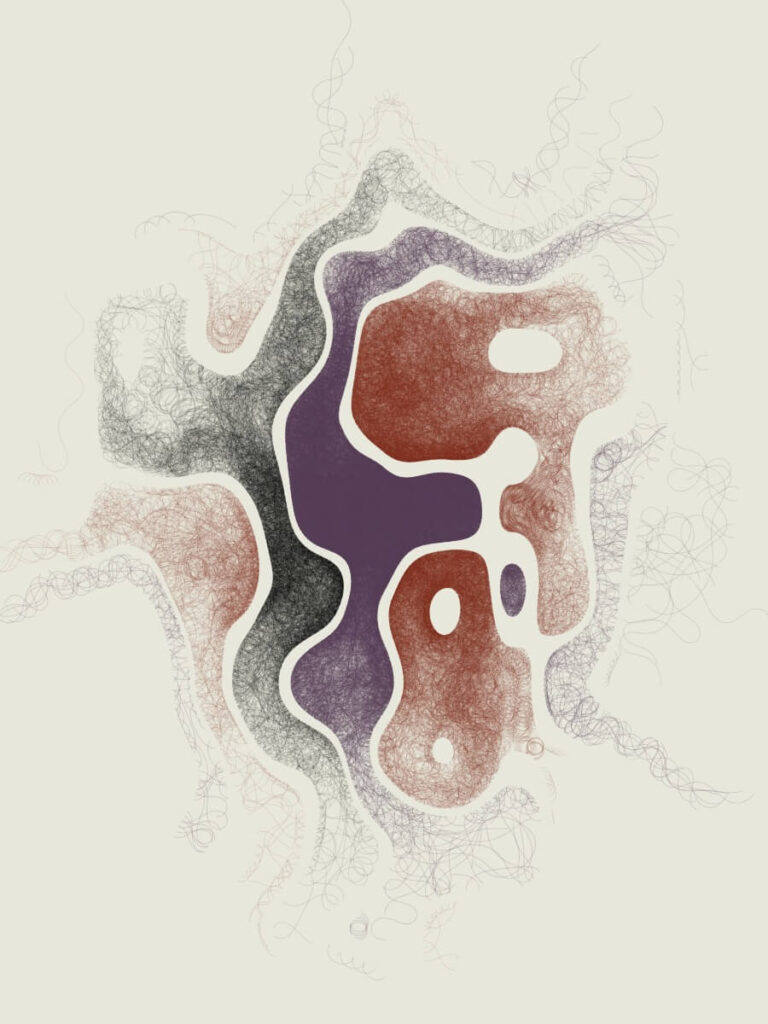
The choice of tools and technologies are guided by the story I want to tell—but sometimes the tool itself inspires the story. A year ago, I began combining traditional techniques with a pen plotter. Each medium has its own rules, and mastering the process takes time. For example, coding how a watercolor brush refills after a certain distance in all SVG drawings took months of testing, and drawing need to be adapt for a 4 mm paintbrush, so not for too tiny lines, the watercolor needs some space to flow the natural gradient of pigment in water. Or simulating constant pressure on a pencil as the tip wears down. My 3D modeling skills help me print custom upgrades for each medium, which I share freely with the community. I find Processing the most accessible way to start coding locally with proper SVG handling. After that, P5.JS and Python have more possibilities. I already use 2D, 3D and animation software on a daily basis.
Do you feel there Is a strong generative art scene? What would you like to see evolve in it
I’m new to the generative art world, so it’s hard to define its strength, but it’s certainly growing. Generative art feels like another segment of art, like watercolor or drawing. Its versatility—across digital, physical, 2D, 3D, or video—connects artists from multiple disciplines, making it a valuable tool for many creators. I also wonder about the impact of AI: with tools like GPT, debugging code is nearly instant, freeing more time to explore and focus on storytelling.
What advice would you give to someone who wants to start creating generative art but doesn’t know where to begin?
Like any technique, start by learning the basics, watch tutorials, reproduce, experiment, and above all—have fun! Don’t be shy and ask questions, the plotter community is really welcoming and sharing, I always answer with pleasure. If you want to get into pen plotting, invest directly in a high-quality plotter like Uunatek Idraw or Axidraw. They cost more, but save time and frustration—cheap machines are often limiting. (I had three cheap before buying a serious one, and I wish someone had told me that earlier, besides it’s always easier to resell a serious product than a bad one.) For any beginner in art, remember: “You don’t have to be great to start, but you have to start to be great” (Zig Ziglar). If you wait until you’re great, you’ll never begin. Simply take the first step. “If you get tired, learn to rest, not to quit.” Banksy I can publish one drawing a day for 10 months straight, sometimes drawing 8 pieces per weekend to publish later. But at some point, I need to stop and recharge. It’s important to accept this pause—it isn’t failure, it’s part of the process. Too many quit instead of resting. Ultimately, creativity is about optimism and love. And in today’s noisy, chaotic world, perhaps the mission of an artist is precisely to find and share a personnal version of beauty.
Which artists or creators do you think are doing remarkable work and deserve much more recognition?
There are so many wonderful artists, it’s impossible to name them all.
- Julien Gachadoat
- Diana
- Licia He
- Mark Webster
- emre meydan
- Nicolas Lebrun
- Joel Cammarata
- Swanny Mouton
- Con Ryan
- Michelle Chandra
And these artists, although well-known, deserve so much more recognition: Vera Molnar, Manfred Mohr, Frieder Nake, Michael Noll, Ellsworth Kelly, Hiroshi Kawano